

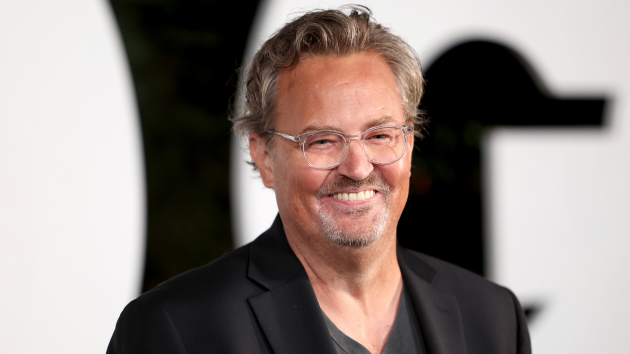
Matthew Perry’s live-in assistant was sentenced on Wednesday to nearly 3 1/2 years in prison for administering the dose of ketamine that killed the Friends actor in 2023.
Kenneth Iwamasa, 61, is one of five people charged and convicted in what federal prosecutors called a conspiracy to illegally distribute ketamine to Perry. The assistant pleaded guilty in August 2024 to one count of conspiracy to distribute ketamine resulting in death.
U.S. District Judge Sherilyn Peace Garnett sentenced him to 41 months in prison and fined him $10,000, the Department of Justice said.
Prosecutors said Iwamasa, the final defendant to be sentenced in the case, injected Perry with ketamine repeatedly in the weeks before the actor’s death without proper medical training — including the fatal dose on Oct. 28, 2023.
“When defendant Kenneth Iwamasa was hired as Matthew Perry’s live-in personal assistant, he was acutely aware that Mr. Perry had suffered from drug addiction for most of his life. But rather than help Mr. Perry maintain sobriety, defendant became his enabler and drug supplier,” prosecutors wrote in a sentencing memorandum ahead of Wednesday’s sentencing hearing in Los Angeles federal court. “As defendant injected more and more ketamine into Mr. Perry, he saw — and was the only person to see — clear warning signs that Mr. Perry was in danger.”
Prosecutors said Iwamasa found Perry unconscious inside his home at least two times in October 2023, as well as seeing him “freeze up” after a large injection, but, “ignoring these warnings,” continued to inject him with illicit ketamine.
In the days leading up to Perry’s death, Iwamasa injected him with “significant quantities of ketamine,” prosecutors wrote. On the day Perry fatally overdosed, Iwamasa injected him with two doses before Perry asked him to prepare the jacuzzi and to “shoot me up a big one,” prosecutors wrote.
Soon after administering the third dose, Iwamasa left to run errands for Perry and, upon returning, found him dead, face down in the jacuzzi, according to prosecutors.
Following Perry’s death, Iwamasa “continued his wrongdoing by destroying evidence and taking other steps to cover his tracks and obstruct justice,” prosecutors wrote. They allege he cleaned up ketamine bottles and syringes from the scene and omitted ketamine from the list of Perry’s medications while being questioned by officers after calling 911.
Iwamasa ultimately provided “significant cooperation” in the government’s investigation, including information on other defendants, prosecutors said while asking for 41 months of imprisonment.
In response to the government’s sentencing memo, defense attorneys argued that Iwamasa did not abuse his “trusted position,” saying he was an employee and “acted at all relevant times at the victim’s direction rather than pursuant to his own discretion.”
“Perhaps Defendant’s employment relationship with the victim enabled him to more readily participate in the conspiracy to distribute drugs to the victim than a man on the street, but it should be noted that a number of proverbial men on the street did in fact participate in the same conspiracy,” they wrote. “Multiple third parties were involved who did not share the same relationship with the victim. That fact alone should overcome the inference that it was Defendant’s particular relationship with the victim that facilitated the crime.”
Prosecutors said Iwamasa worked with two doctors to obtain ketamine for Perry, before turning to two dealers to obtain dozens of vials of ketamine, including the doses that killed the actor.
Iwamasa had known Perry since around 1992 before becoming his live-in assistant in 2022 for $150,000 a year, according to prosecutors. His responsibilities included those related to Perry’s medical care, they said.
In a victim impact statement filed ahead of the sentencing, Perry’s mother said the family was relieved when Perry took on an assistant whom she said understood the actor’s battles with drug addiction, and that they all trusted Iwamasa.
“Kenny’s most important job — by far — was to be my son’s companion and guardian in his fight against addiction. His number one responsibility — ensure that Matthew remained what he wanted to be: drug free,” she wrote. “Kenny knew, should he feel unduly pressured, that with one phone call to any number of the people in Matthew’s orbit, reinforcements would be on the way, and his job would be safe.”
“But instead of protecting Matthew, he aided and abetted illegal drug taking, arranged for one source of supply, then another. Shot the drugs into Matthew’s body though he was not in the least qualified,” she continued. “He did it even though he could see, anyone could have seen, it was so obviously dangerous. And he did it again and again.”
Iwamasa is the fifth and final defendant in the case to be sentenced in the scheme to illegally distribute ketamine to Perry.
Prosecutors said Jasveen Sangha, reportedly known as the “Ketamine Queen,” worked with Erik Fleming to distribute 51 vials of her ketamine to Iwamasa, including the doses that killed Perry.
Sangha was sentenced last month to 15 years in prison. She pleaded guilty last year to one count of maintaining a drug-involved premises, three counts of distribution of ketamine and one count of distribution of ketamine resulting in death or serious bodily injury.
Fleming was sentenced earlier this month to two years in prison after pleading guilty to one count of conspiracy to distribute ketamine and one count of distribution of ketamine resulting in death.
The two doctors convicted in the case were sentenced last year.
Mark Chavez, who once ran a ketamine clinic, admitted to selling fraudulently obtained ketamine to Salvador Plasencia, who briefly treated Perry, which was then sold to the actor in the weeks before his death.
Chavez pleaded guilty to one count of conspiracy to distribute ketamine and was sentenced to eight months of home confinement in December 2025.
Plasencia pleaded guilty to four counts of distribution of ketamine and was sentenced to 30 months in prison in December 2025.
They both surrendered their medical licenses.
Copyright © 2026, ABC Audio. All rights reserved.
